Ising Chains
Purpose and structure
These spin-$\tfrac12$ chains combine Ising $ZZ$ interactions with transverse and optional longitudinal fields. The next-nearest-neighbor variant adds frustration. They are standard small-system benchmarks for phase-transition intuition, quantum simulation, and variational algorithms. The transverse-field model also supports explicit global spin-flip parity sectors.
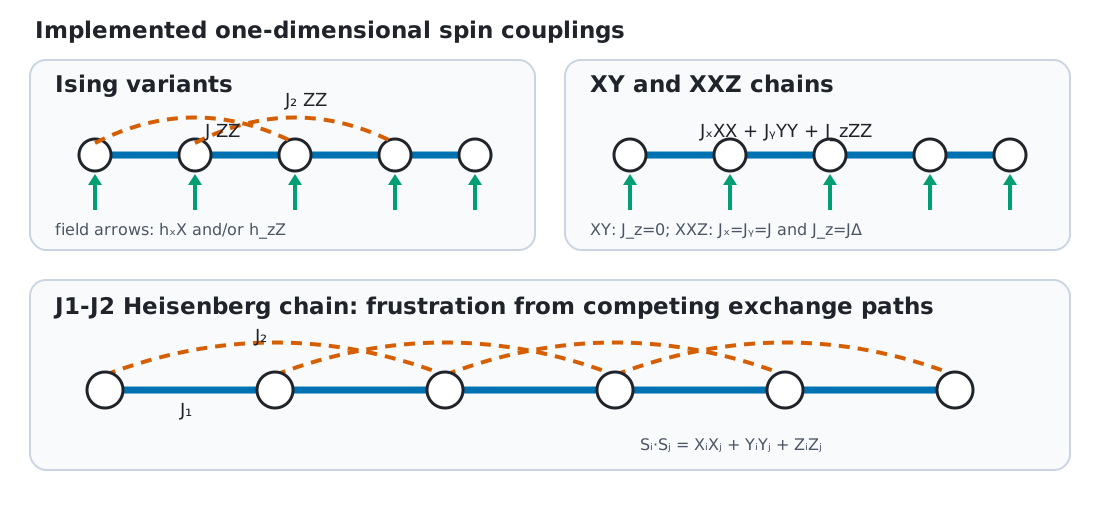
Hamiltonians
$$ H_{\rm TFIM}=-J\sum_i Z_iZ_{i+1}-h\sum_iX_i, $$
$$ H_{\rm long}=-J\sum_iZ_iZ_{i+1}-h_x\sum_iX_i-h_z\sum_iZ_i, $$
$$ H_{\rm NNN}=-J_1\sum_iZ_iZ_{i+1}-J_2\sum_iZ_iZ_{i+2}-h\sum_iX_i. $$
The operators are Pauli matrices, not spin operators divided by two.
For the transverse-field model,
$$ P=\prod_i X_i,\qquad [H_{\rm TFIM},P]=0, $$
so the Hamiltonian can be reduced to either parity eigenvalue $p=\pm1$.
Basis and scaling
The full computational basis has dimension $2^N$. The ordinary builder returns
a dense DenseHamiltonian; the compatible _sparse builder returns a CSR
matrix.
Each spin-flip parity sector has dimension $2^{N-1}$. Its basis rows are the normalized superpositions
$$ |s;p\rangle=\frac{|s\rangle+p|\bar{s}\rangle}{\sqrt{2}}, $$
where $|\bar{s}\rangle$ is the bitwise-complement state. The sector builder
returns a SpinParitySectorHamiltonian containing a CSR matrix and a portable
reduced-basis mapping with both components and coefficients.
Package use
from quantum_lattice_models import (
    transverse_field_ising,
    transverse_field_ising_parity_sector,
)

H = transverse_field_ising(n_sites=6, j=1.0, h=0.7, periodic=False)
even = transverse_field_ising_parity_sector(
    n_sites=6,
    parity=1,
    j=1.0,
    h=0.7,
    periodic=False,
)
H_even = even.matrix
quantum-lattice create transverse_field_ising --n-sites 6 --j 1 --h 0.7 --output ising.json
quantum-lattice create transverse_field_ising_parity_sector_sparse \
  --n-sites 6 --parity 1 --j 1 --h 0.7 --output ising-even.json
Parameters
| Builder | Parameter | Type | Default | Constraint |
|---|---|---|---|---|
transverse_field_ising |
n_sites |
int |
4 |
>= 1 |
transverse_field_ising |
j |
float |
1.0 |
|
transverse_field_ising |
h |
float |
0.5 |
|
transverse_field_ising |
periodic |
bool |
False |
|
longitudinal_field_ising |
n_sites |
int |
4 |
>= 1 |
longitudinal_field_ising |
j |
float |
1.0 |
|
longitudinal_field_ising |
h_x |
float |
0.5 |
|
longitudinal_field_ising |
h_z |
float |
0.1 |
|
longitudinal_field_ising |
periodic |
bool |
False |
|
next_nearest_neighbor_ising |
n_sites |
int |
5 |
>= 1 |
next_nearest_neighbor_ising |
j1 |
float |
1.0 |
|
next_nearest_neighbor_ising |
j2 |
float |
0.25 |
|
next_nearest_neighbor_ising |
h |
float |
0.5 |
|
next_nearest_neighbor_ising |
periodic |
bool |
False |
|
transverse_field_ising_parity_sector_sparse |
n_sites |
int |
6 |
>= 1 |
transverse_field_ising_parity_sector_sparse |
parity |
int |
1 |
|
transverse_field_ising_parity_sector_sparse |
j |
float |
1.0 |
|
transverse_field_ising_parity_sector_sparse |
h |
float |
0.5 |
|
transverse_field_ising_parity_sector_sparse |
periodic |
bool |
False |
Validation and cautions
The zero-field three-site spectrum is checked analytically. Parity mappings are checked as orthonormal eigenbases of $P$, each reduced matrix is compared with an explicit full-space isometric reduction, and the two sector spectra are verified to recombine into the full spectrum.
Dense memory grows as $4^N$. A parity sector halves the matrix dimension but does not remove exponential scaling, so inspect the estimated dimension and storage before increasing $N$. A nonzero longitudinal $Z$ field breaks the global spin-flip symmetry and is not supported by the parity-sector builder.