NRSSH Results
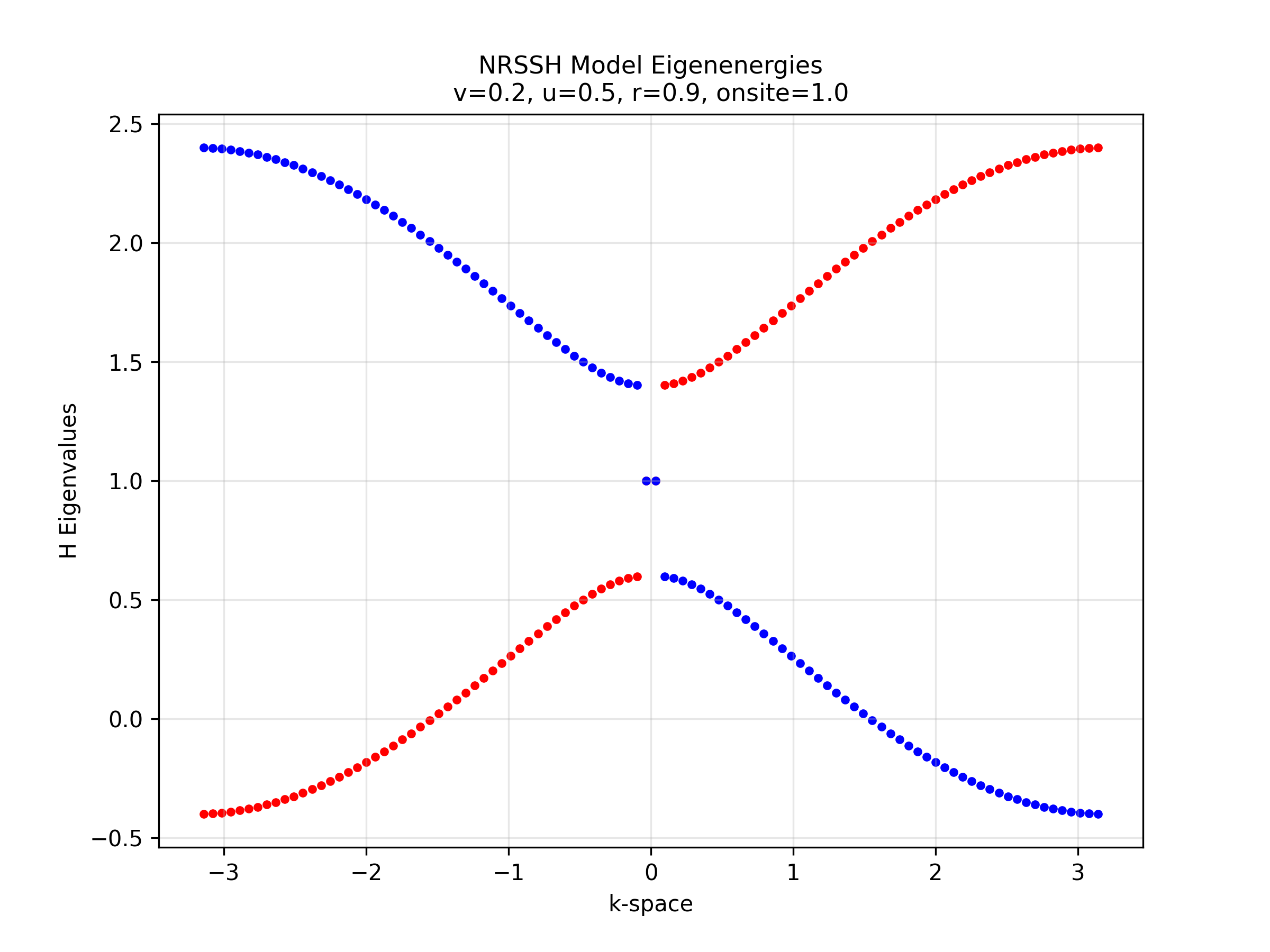
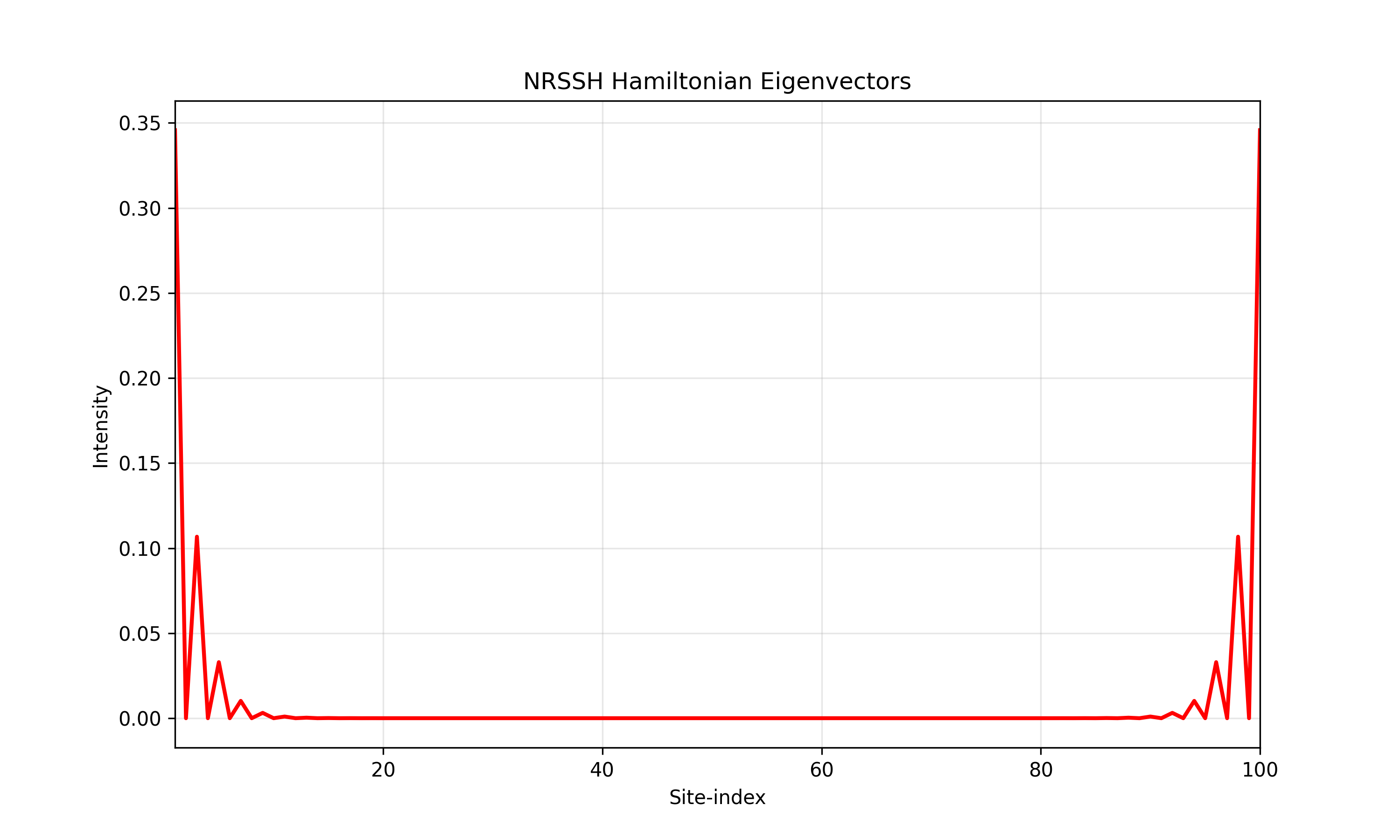
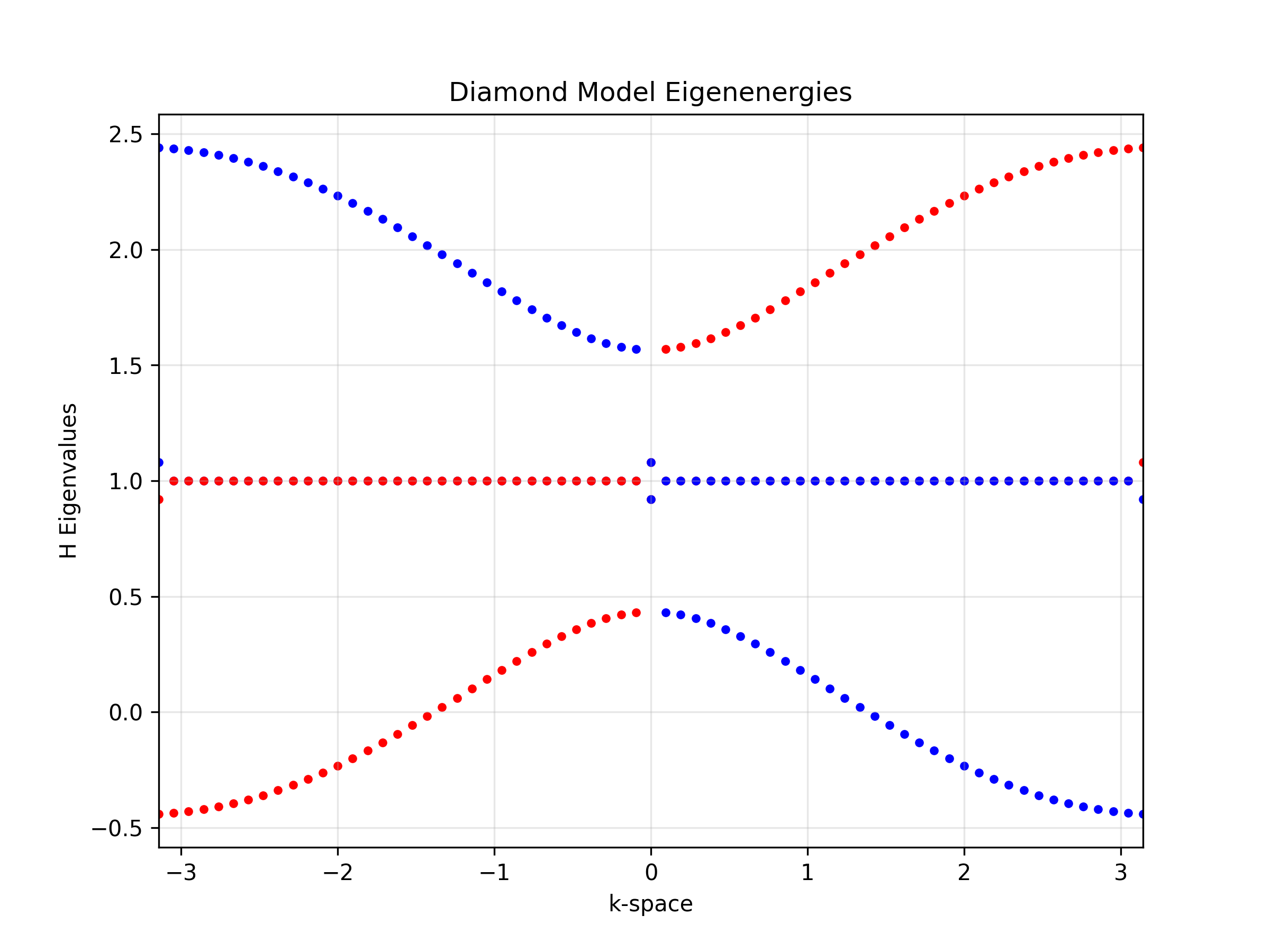
The NRSSH eigenenergies are plotted in \(k\)-space over the first Brillouin zone. Because this model's Hamiltonian is independent of \(k\), the plotted bands reveal isolated edge states in the band gap.
Phase diagrams
In the saturated NRSSH model, convergence times become continuous in the lossy phase, slightly above the threshold line \(\gamma_1 = (1 + S)\gamma_2 = 2\gamma_2\). Below this line the system enters a gain-dominated laser-oscillation phase.
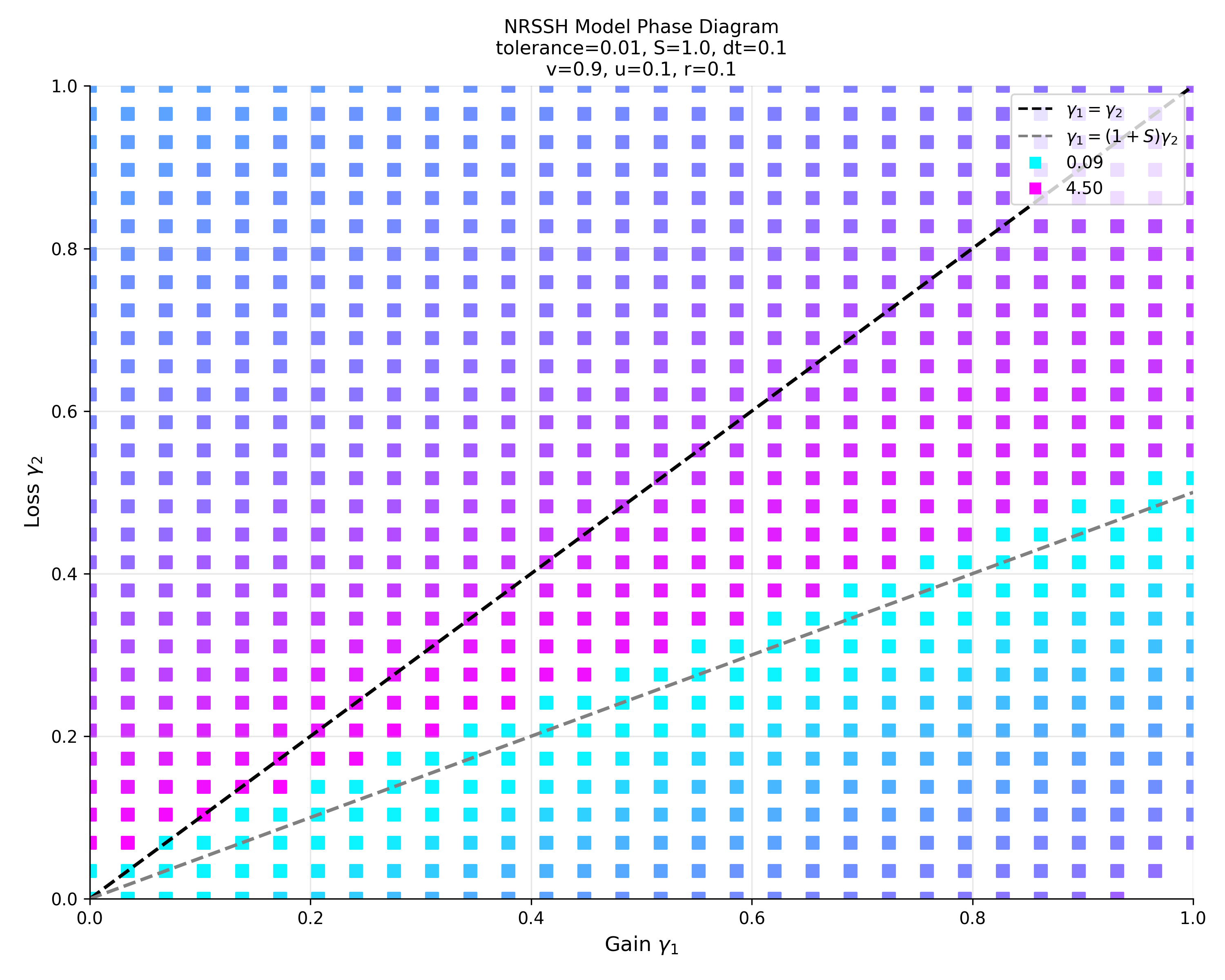
Without saturation, points below \(\gamma_1 = \gamma_2\) grow exponentially, so the tolerance condition is not satisfied and the system is unstable.
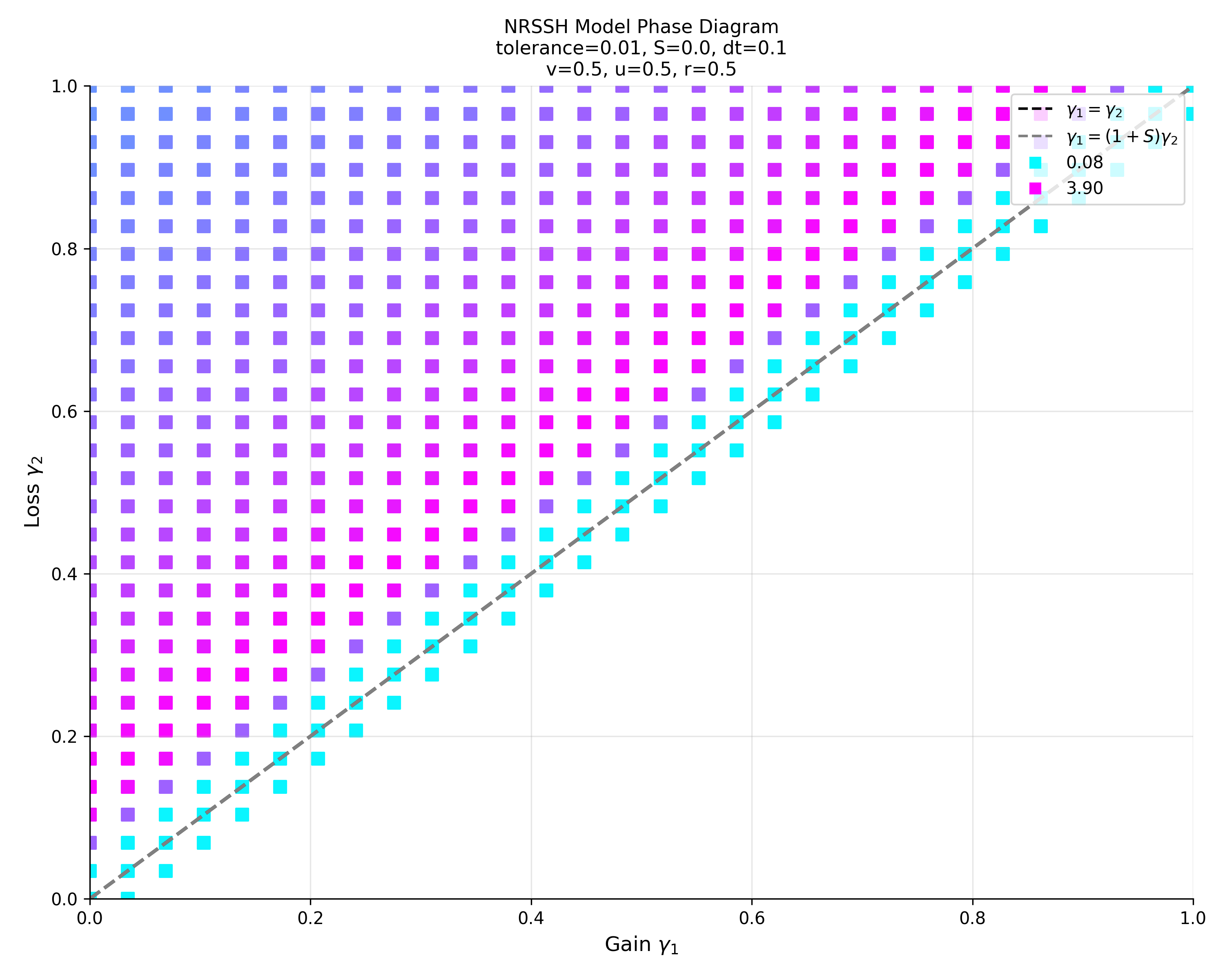
Chaotic behavior appears near points such as \((\gamma_1 = 0.9, \gamma_2 = 0.15)\), where convergence is sensitive to small changes in initial conditions or parameters.
Diamond Results
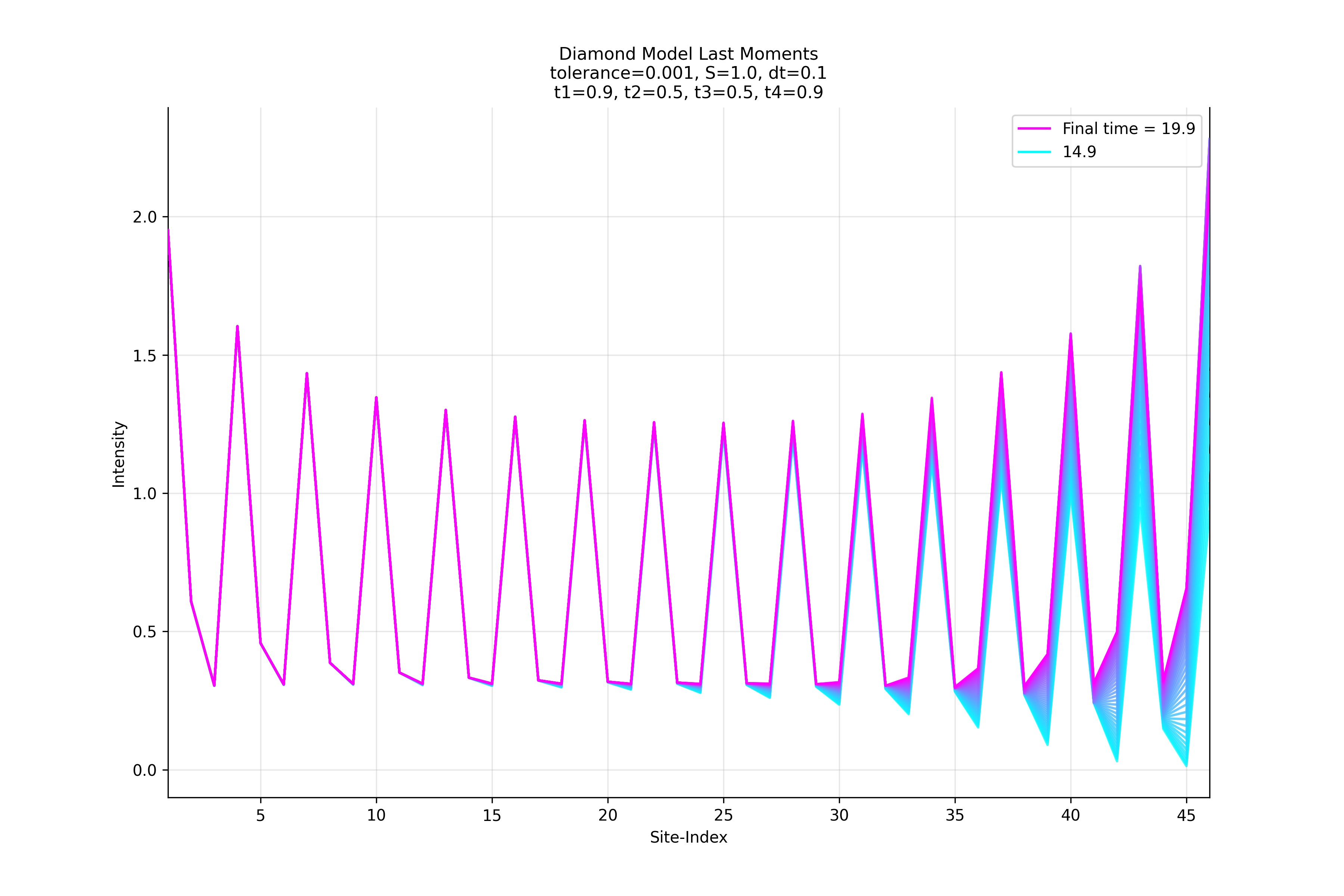
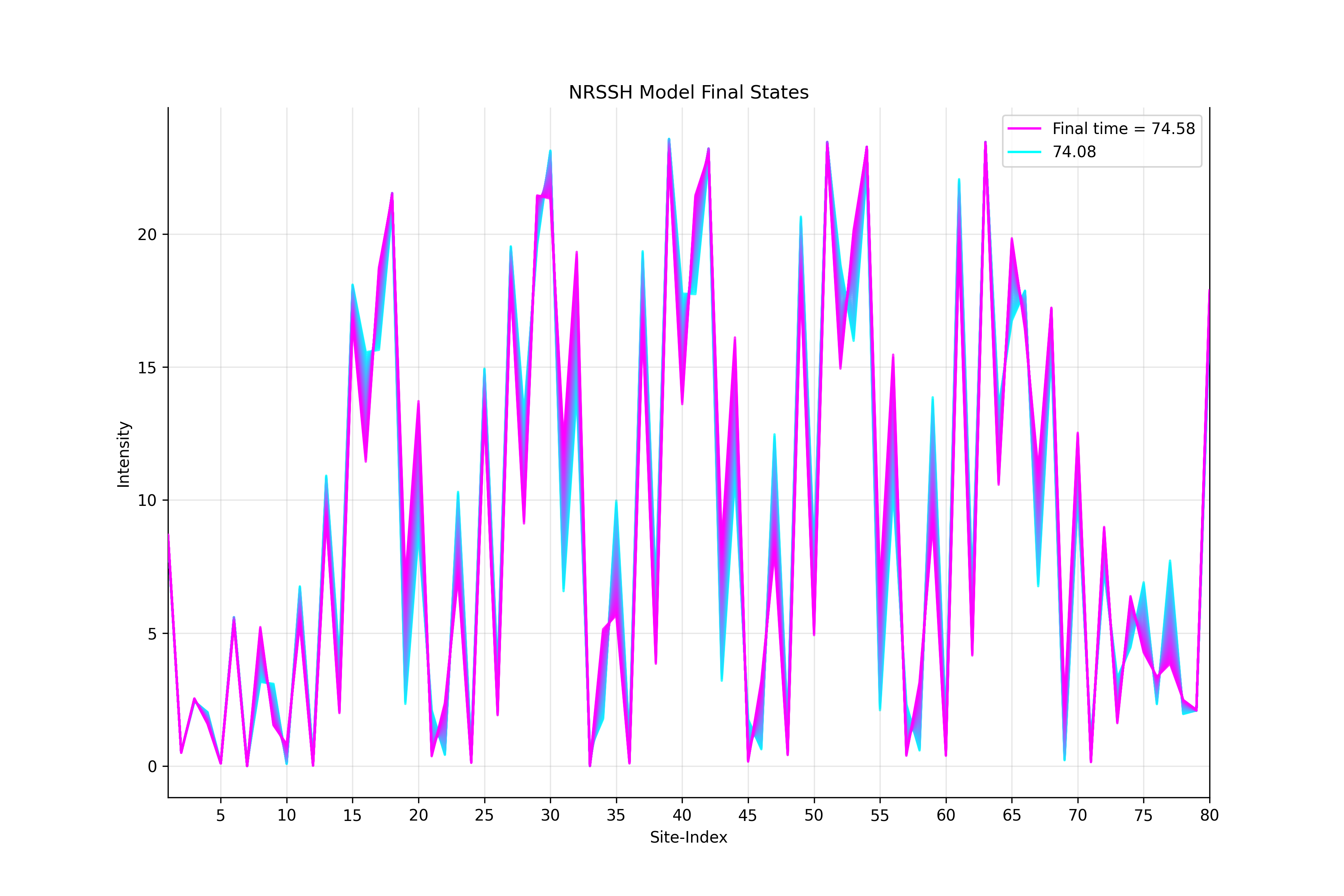
Diamond lattices host localized hybrid states near \(k = 0\), and their gain/loss structure differs from NRSSH because A sites carry nonlinear saturable gain while B and C sites carry loss.
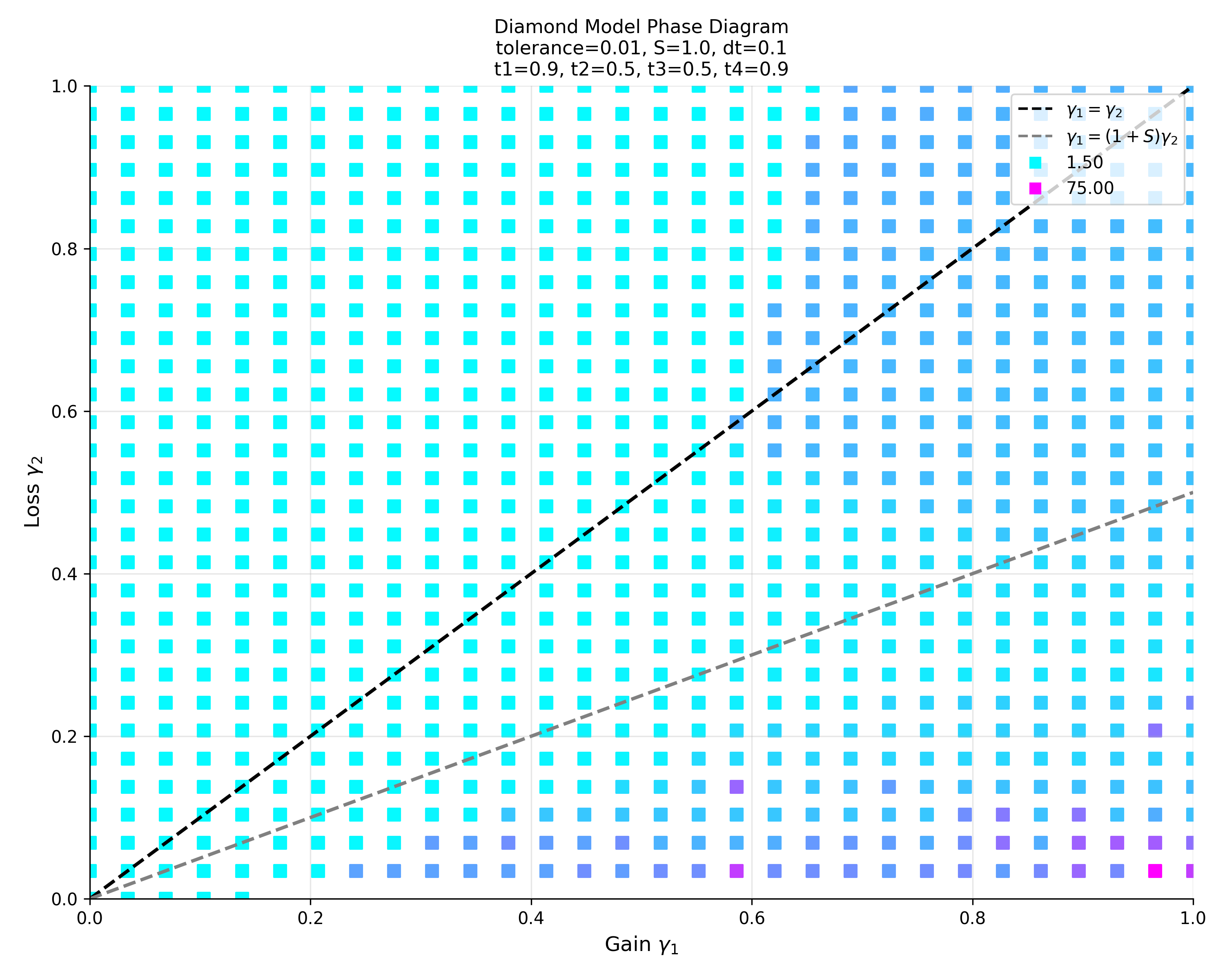
In the equal-hopping baseline, the phase boundary is not linear even though \(\gamma_1 = (1 + S)\gamma_2\) remains a useful visual guide.
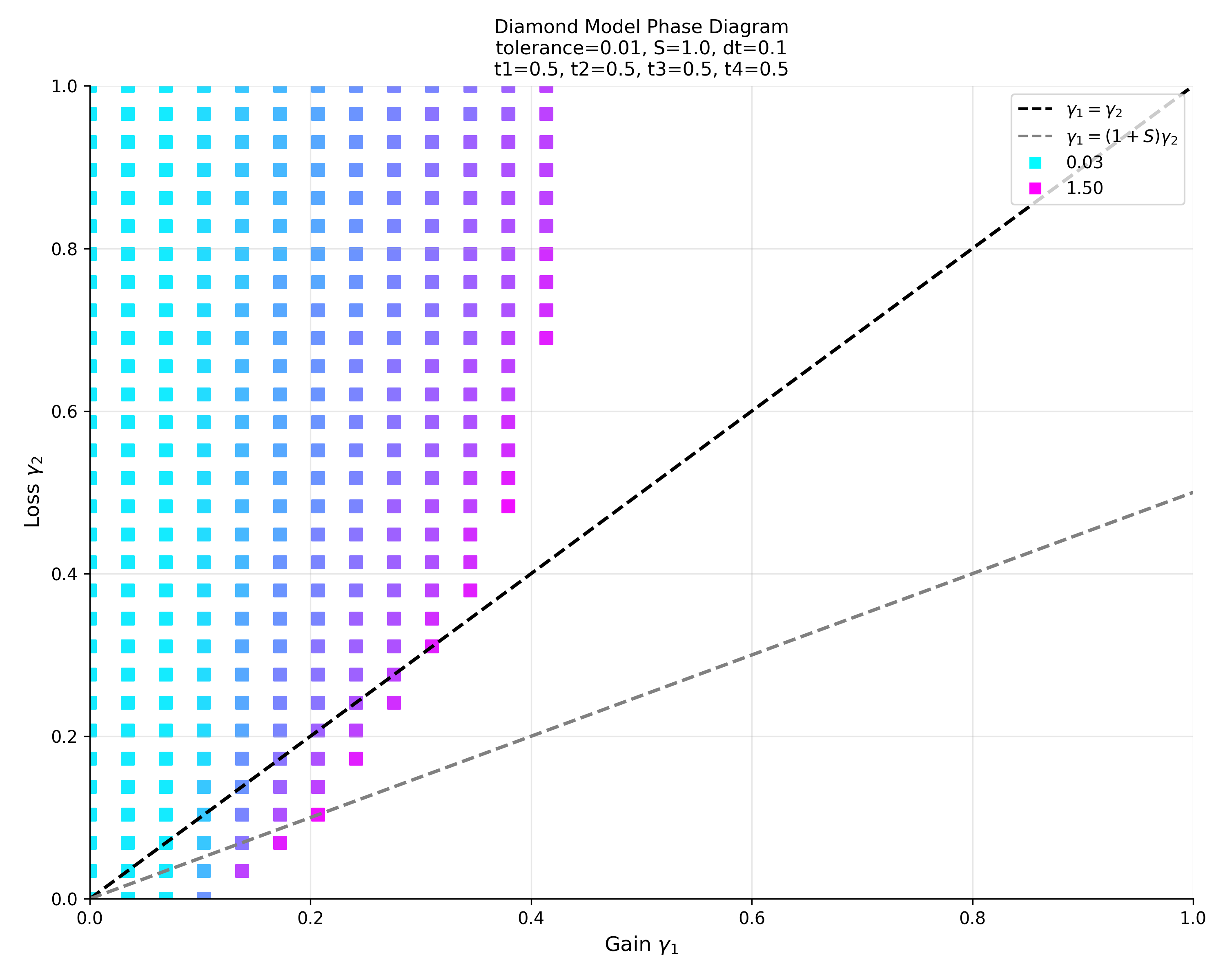
Facing dimerization is the standout regime. It produces stable topological phases, visible critical behavior near \((\gamma_1 = 0.95, \gamma_2 = 0.35)\), and edge localization at points such as \((\gamma_1 = 0.9, \gamma_2 = 0.8)\).