Lattice Models
Non-Reciprocal SSH Model
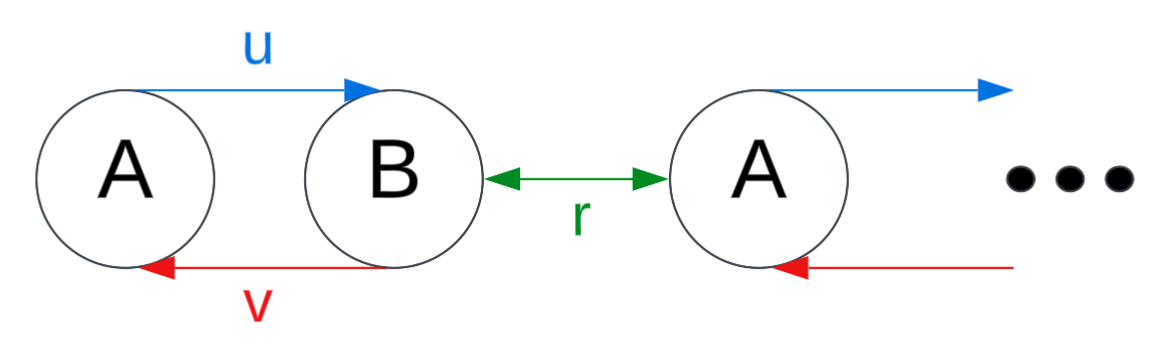
The NRSSH model uses intra-cell hoppings \(v\) and \(u\), inter-cell hopping \(r\), and onsite potential \(\epsilon\). Setting \(v = u\) recovers the SSH model, while \(v = u = r\) gives the trivial tight-binding limit.
Diamond Model
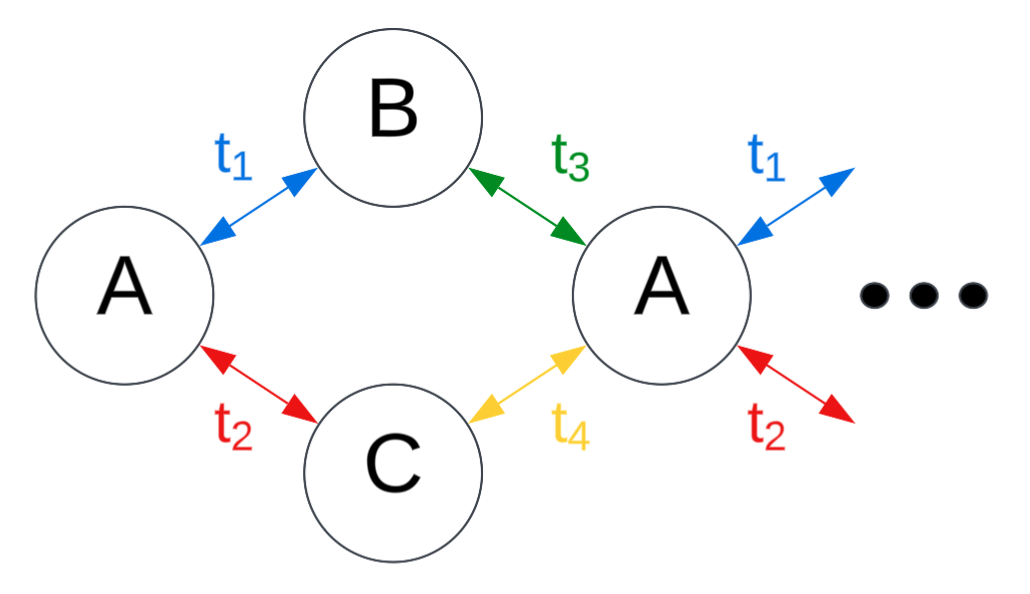
The Diamond model uses hoppings \(t_1\), \(t_2\), \(t_3\), and \(t_4\). Facing dimerization satisfies \(t_1 = t_4\) and \(t_2 = t_3\); neighbouring dimerization satisfies \(t_1 = t_3\) and \(t_2 = t_4\); and the intra/inter case satisfies \(t_1 = t_2\) and \(t_3 = t_4\).
Gain and Loss
Nonlinear saturable gain is controlled by gain \(\gamma_1 \in (0, 1]\), loss \(\gamma_2 \in (0, 1]\), and saturation \(S \geq 0\). The onsite nonlinear gain term is:
NRSSH applies gain and loss on all sites. Diamond applies nonlinear saturable gain on A sites and constant loss \(\gamma_2\) on B and C sites.
Time Evolution
Natural units set \(\hbar = 1\) and often \(c = 1\), so \(p = \hbar k\) lets \(k\)-space represent momentum-space. The Schrodinger equation is:
The first-order operator is:
The simulations use a second-order operator based on the \(\pm dt / 2\) update:
Phase Classification
- Lossy phase: intensities diminish and energy dissipates.
- Stable phase: intensities converge smoothly and can host edge modes.
- Unstable phase: nonlinear gain dominates and intensities grow indefinitely.
- Chaotic phase: final-state times are irregular and parameter-sensitive.
- Blended phase: neighbouring points mix chaotic, stable, or lossy behavior.