Results
The results pages collect the current numerical evidence for the package: notebook execution, QSVT-vs-classical agreement, polynomial design diagnostics, and committed artefacts that can be regenerated from the command line.
The repository root RESULTS.md remains the compact
source-of-truth ledger. This page is the portfolio-style summary for rendered
documentation.
Current Status
validation target |
current result |
source |
|---|---|---|
tutorial notebooks |
all execute in notebook validation |
|
real-example notebooks |
all execute in notebook validation |
|
benchmark notebooks |
all execute in notebook validation |
|
fast unit/regression suite |
algorithm workflows and CLI report paths covered |
|
package artefacts |
source distribution and wheel build cleanly |
|
rendered plots |
tutorial, real-example, and benchmark PNG artefacts committed, including setup schematics |
|
Key Outcomes
Polynomial design improves predictably with degree
The committed sign-design sweep uses gamma=0.2, evaluates degrees
5, 9, 13, 17, and skips PennyLane synthesis so the table isolates polynomial
design diagnostics. A companion filter sweep uses cutoff=0.4 and degrees
6, 10, 14, 18.
degree |
max error |
RMS error |
QSVT-compatible checks |
|---|---|---|---|
5 |
|
|
passed sampled boundedness/parity checks |
9 |
|
|
passed sampled boundedness/parity checks |
13 |
|
|
passed sampled boundedness/parity checks |
17 |
|
|
passed sampled boundedness/parity checks |
Artefact:
results/reports/sign-degree-sweep.json
Filter design also benefits from degree tuning
The filter sweep shows that different design families can have non-monotonic maximum error at low degree while still improving in RMS error and boundedness margin as the polynomial space grows.
degree |
max error |
RMS error |
QSVT-compatible checks |
|---|---|---|---|
6 |
|
|
passed sampled boundedness/parity checks |
10 |
|
|
passed sampled boundedness/parity checks |
14 |
|
|
passed sampled boundedness/parity checks |
18 |
|
|
passed sampled boundedness/parity checks |
Artefacts:
Regenerate:
qsvt design-sweep \
  --kind sign \
  --degrees "5,9,13,17" \
  --gamma 0.2 \
  --num-points 401 \
  --bounded-num-points 801 \
  --no-synthesis \
  --output results/reports/sign-degree-sweep.json
qsvt design-sweep \
  --kind filter \
  --degrees "6,10,14,18" \
  --cutoff 0.4 \
  --sharpness 12 \
  --num-points 401 \
  --bounded-num-points 801 \
  --no-synthesis \
  --output results/reports/filter-degree-sweep.json
QSVT transforms agree with direct spectral references
The committed scalar/diagonal and Hermitian matrix reports compare explicit QSVT transforms with direct classical polynomial evaluation.
artefact |
transform |
max error |
RMS error |
|---|---|---|---|
diagonal |
|
|
|
Hermitian matrix |
|
|
Algorithm workflows are regression-tested
The fast test suite covers deterministic small-matrix regressions for:
positive-definite linear-system approximation
Gaussian ground-state filtering
real-time Hamiltonian simulation
resolvent / Green’s-function response
spectral-density estimation
thermal Gibbs weighting
These tests protect the package-level workflow APIs separately from the longer notebook execution checks.
Representative Figures
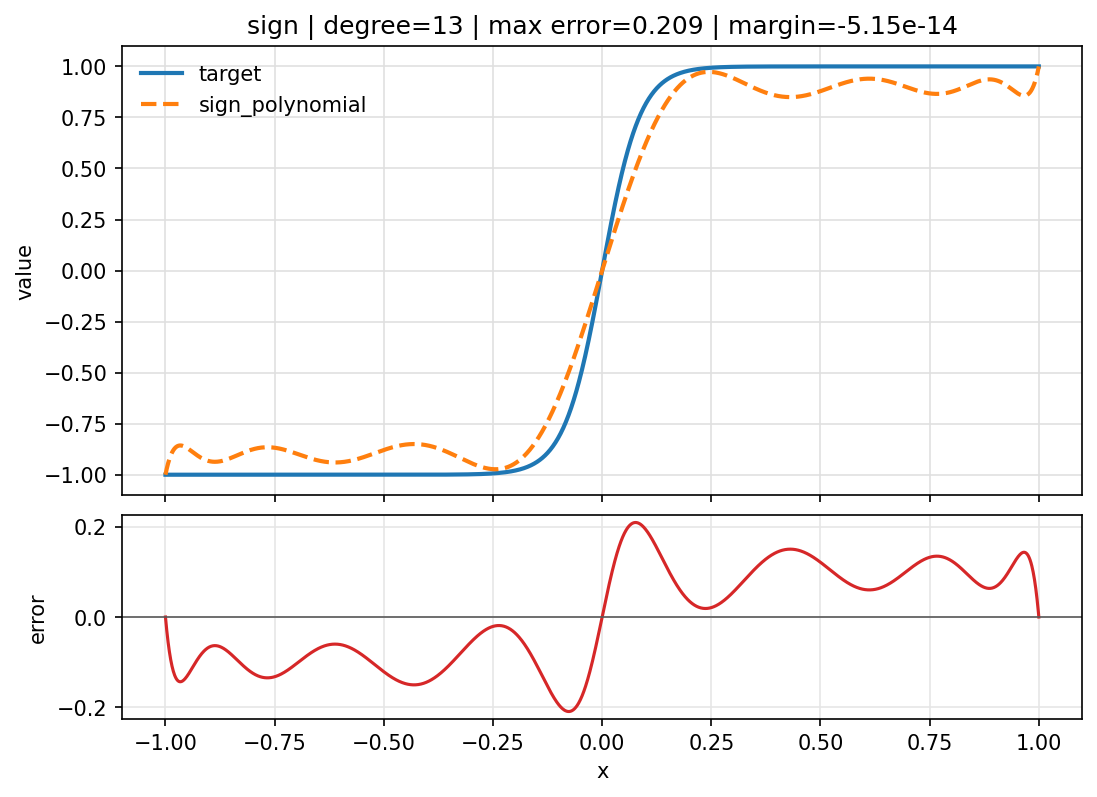
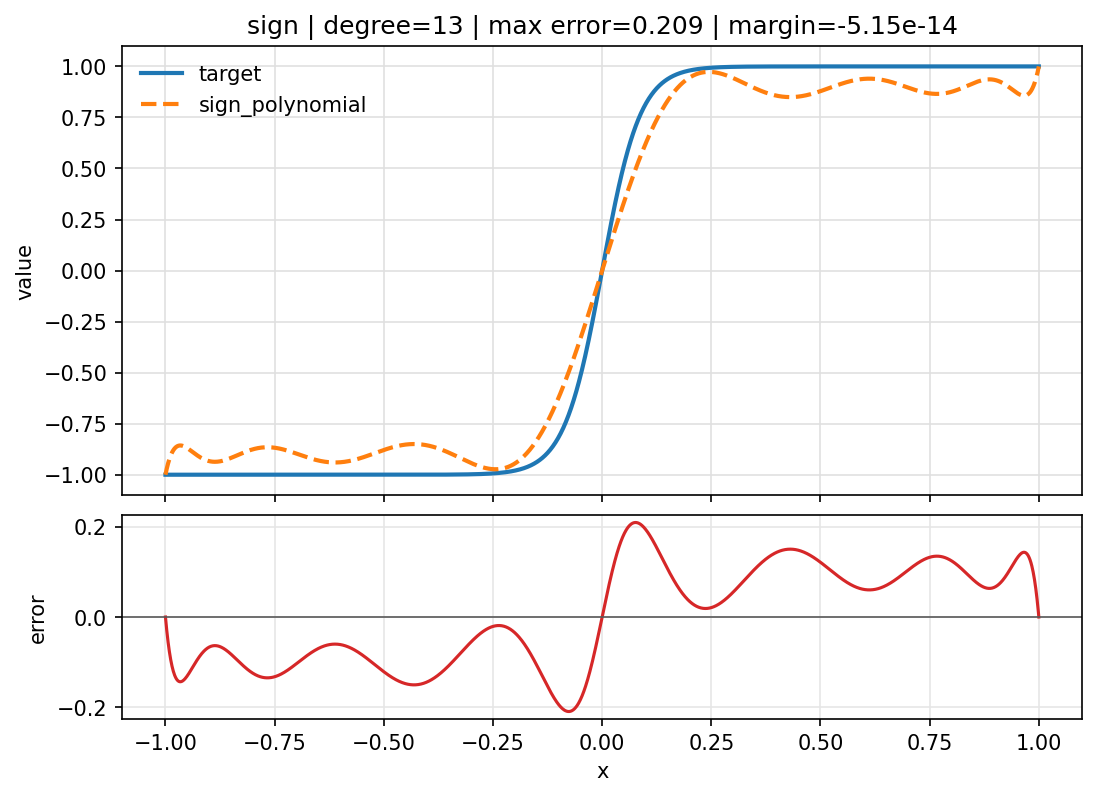
Degree-13 sign design report showing the target, polynomial fit, and residual structure.
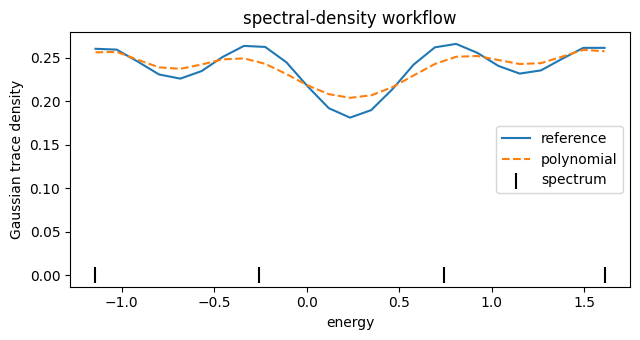
QSVT algorithm workflow diagnostics from the tutorial sequence.
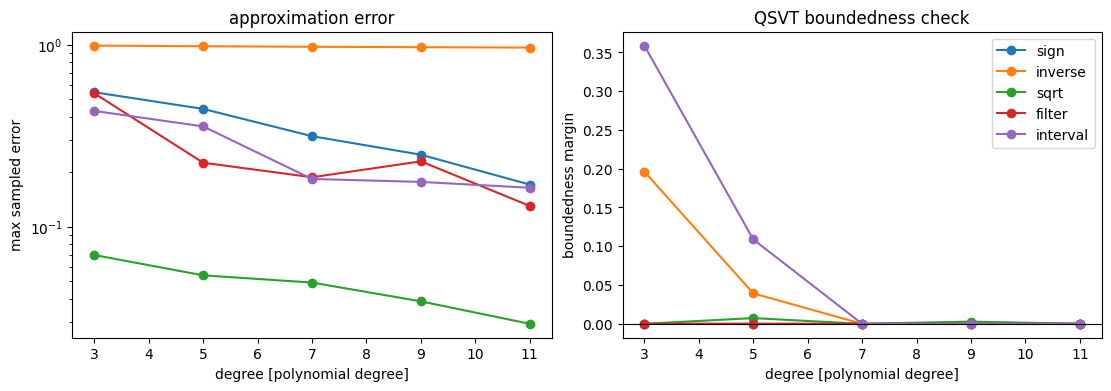
Degree/error/boundedness tradeoff results for QSVT-compatible polynomial design.
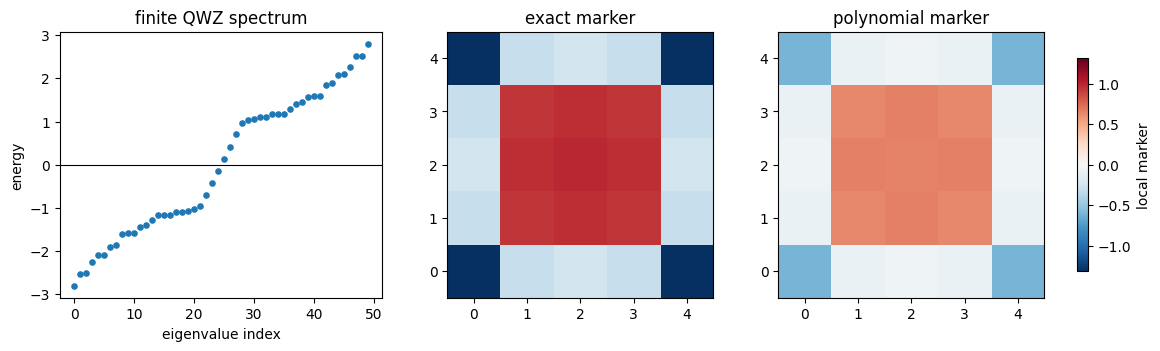
Topological band-projector example using a small Qi-Wu-Zhang lattice model.
Generated notebook output pages:
The real-example output page now includes setup schematics alongside quantitative diagnostics for the physical systems represented in the notebooks.
Artefact Ledger
artefact |
workflow |
notes |
|---|---|---|
sign design report |
degree-13 sign approximation with |
|
sign design plot |
target-vs-polynomial diagnostic plot |
|
design sweep |
degree/error/boundedness manifest |
|
design sweep |
filter degree/error/boundedness manifest |
|
sweep summary |
tabular summary of committed design-sweep reports |
|
diagonal QSVT comparison |
direct |
|
Hermitian matrix QSVT comparison |
spectral polynomial reference comparison |
|
release summary table |
compact index over generated JSON reports |
|
real-example manifest |
machine-readable ledger for real-example PNG outputs |
Regeneration
Execute notebooks, extract their embedded outputs, and regenerate the rendered result pages:
python scripts/extract_notebook_plots.py --preset all --execute --write-docs
Refresh the pages from already-saved notebook outputs without re-executing:
python scripts/extract_notebook_plots.py --preset all --write-docs
Generate the committed report examples:
qsvt design-report --kind sign --gamma 0.2 --degree 13 \
  --output results/reports/sign-report.json \
  --plot results/plots/sign-report.png
qsvt compare-report \
  --values "1.0,0.7,0.3,0.1" \
  --poly "0,0,1" \
  --wires 3 \
  --output results/reports/qsvt-report.json
qsvt matrix-report \
  --matrix "0.31351701,-0.23499807;-0.23499807,0.68648299" \
  --poly "0,0,1" \
  --output results/reports/matrix-report.json